Symposium 2026
A look back:
On resilience, failure rates, fraud, AI and the human factor
Numerous guests are using the event as an opportunity to exchange ideas
Factoring market remains resilient despite global challenges
Effective data and risk management is crucial in preventing failures
Fraud prevention using AI-powered early-warning systems and staff expertise
Agentic AI offers great potential for automation and efficiency
AI: It is not so much about knowing a lot, but about thinking for oneself
At this year’s Factoring Symposium, we were once again delighted to welcome numerous guests from both Germany and abroad. Whether clients, partners or prospective customers: they all took the opportunity not only to find out about the latest industry developments, but also to exchange views with one another. What are the current issues facing the factoring industry? What does the future hold? And: What’s new at efcom? Answers to these questions were provided by the speakers on stage as well as by our colleagues at various ‘hands-on stations’ – small stands where visitors could find out more about our products and new developments.
Factoring market defies global uncertainty
The first speaker to take to the stage was Betül Kurtulus, in her capacity as Deputy Secretary-General of the FCI. She presented the association’s latest figures, which show that the factoring market is proving resilient despite global uncertainties. Global factoring volume reached over 4.04 trillion euros in 2025 (+3.7 per cent year-on-year). Long-term growth remains stable at 7.1 per cent. What was the situation in the individual regions? Europe remains the global centre: with a volume of 2.66 trillion euros, it holds a global market share of just under 66 per cent. Within Europe, Germany recorded strong growth of 6.3 per cent. North America grew massively by 35.1 per cent to 160 billion euros, whilst South America increased by 8.2 per cent to 165 billion euros. The Asia-Pacific region remains stable at 995 billion euros (+3.2 per cent). The Middle East recorded growth of 8.7 per cent (to 8.8 billion euros), whilst Africa stands at 51.4 billion euros. According to the FCI, both regions offer enormous, as yet untapped potential.
What other milestones and trends were there? Among other things, Betül mentioned the European EBA Directive, which brings about a crucial change for true factoring – an extension of the exemption period for overdue invoices to 90 days. She also highlighted the digitalisation drive in the Middle East. Countries such as Saudi Arabia and the UAE are driving forward national e-invoicing models by 2026, which reduces the risk of fraud and facilitates supply chain finance (SCF). Last but not least, Betül reported on a new comprehensive factoring law in Nigeria that is awaiting final signature by the President – this could serve as a blueprint for the entire region.
At FCI itself, the focus is on expanding reverse factoring and Islamic factoring. According to Betül, future growth depends largely on legal certainty, digital infrastructure and appropriate regulatory treatment. FCI sees this as one of its core tasks: connecting the global industry and creating sustainable framework conditions.
Effective data and risk management is crucial
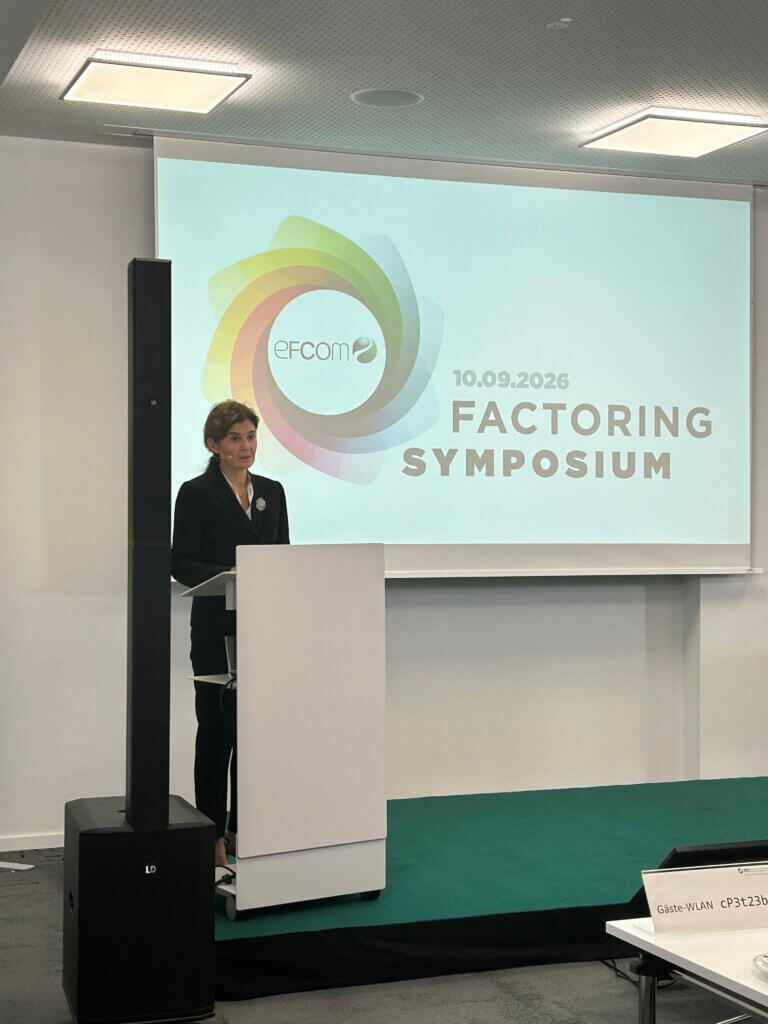
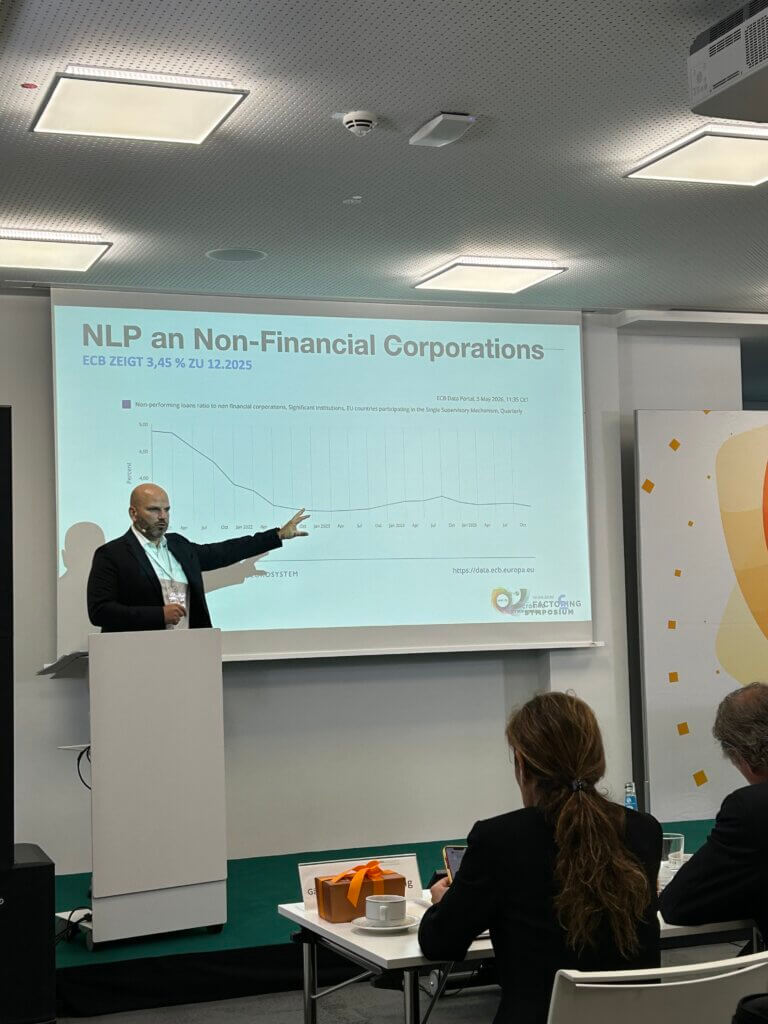
The second presentation, given by Roland Reiser (Creditreform), focused on SME classification and capital relief for banks, rising default risks among small and medium-sized enterprises (SMEs), as well as current economic pressures and their impact on financing and factoring. Creditreform possesses extensive data on companies, creditworthiness and payment history, and combines this with manual research. This information is increasingly being made available digitally and via APIs. By ensuring correct SME classification in accordance with the CRR, banks can utilise the SME supporting factor and thereby reduce their capital requirements or RWA. A robust assessment of turnover, group affiliation and economic interdependencies is crucial.
In addition to the SME factor, external ratings can help to optimise capital requirements for larger financing arrangements. Preliminary screenings can help to identify suitable cases and avoid unnecessary rating costs. At the same time, the economic environment is deteriorating: insolvencies, payment delays and business closures are on the rise. Therefore, savings achieved through the SME factor should not be viewed in isolation, but should also be taken into account in risk provisioning and risk management.
The combination of economic uncertainty, rising financing costs, longer payment terms and potential fraud risks makes effective data and risk management all the more important. Refinancing institutions and factoring companies therefore face the challenge of capitalising on regulatory capital advantages whilst consistently monitoring the actual credit risk.
Fraud prevention: clarity, consistency, AI and expertise
During the subsequent panel discussion, Wolf Stumpf from the law firm Noerr, Alexander Ries, Managing Director of TEBA Bank, and the two efcom colleagues Federicon Avellán Borgmeyer (Chief Partner Officer) and Dr Vinai George Biju (Data Scientist) took to the stage. The discussion centred on an extremely sensitive topic: fraud. The speakers reported on cases involving both long-standing, trustworthy clients and fraudsters who had been specifically targeted. Typical methods included forged invoices, delivery notes and emails, as well as manipulated financial information. In some instances, the fraud had been in the making for years. How can one protect oneself against this? Key measures include clear contractual rights to audit and access information, verification thresholds, confirmation of claims, regular external audits and ad hoc on-site inspections. Customers should be required to proactively report any anomalies or changes in their financial circumstances.
AI and data analysis can be used to identify unusual patterns, such as duplicate invoices, suspicious credit notes, unusual direct payments, persistently high receivables or atypical changes in turnover and receivables. The aim is to detect suspicious trends as early as possible. Nevertheless, human judgement remains crucial. After all, the systems are designed to support people, not replace them. Anomalies detected automatically must be reviewed by staff, as false alarms can occur. A combination of automated analysis and targeted on-site checks is particularly effective.
If a suspicion arises, the facts must first be established; where necessary, external auditors or investigators should be brought in, and legal and insurance-related aspects must be taken into account. It is crucial not to wait too long, as assets may otherwise disappear or be transferred abroad. Fraud prevention should therefore not be limited to individual checks. Staff must be made aware of warning signs and unusual customer behaviour. It is also important to note that, following a case of fraud, the primary focus should not be on finding those responsible, but on identifying which processes can be improved. Ultimately, effective fraud prevention in factoring stems from the interplay of clear contracts, rigorous checks, data- and AI-driven early-warning systems, and experienced staff who can assess anomalies and act swiftly.
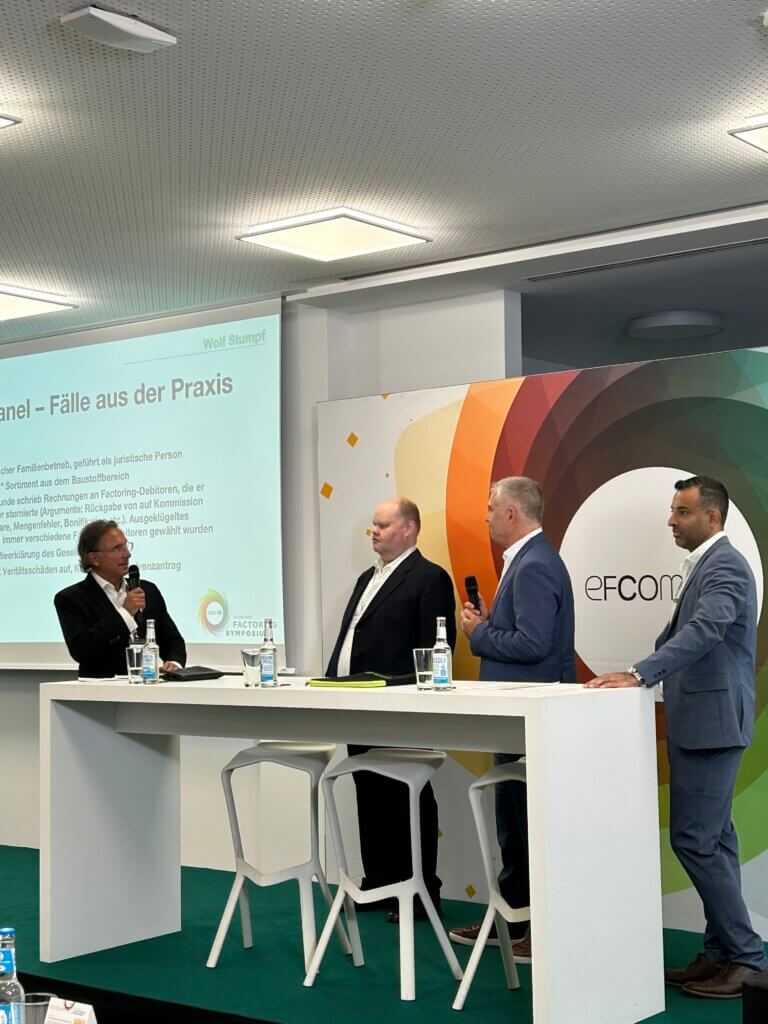
From left to right: Federico Avellàn Borgmeyer, Wolf Stumpf, Alexander Ries, Dr Vinai George Biju
Agentic AI: great potential, combined with security and control
The subsequent presentation slot featured two speakers: whilst Dr Björn Engelmann from the Fraunhofer Institute IAIS reported on the current state of play in the field of agentic AI, Dinko Mehmedagic from Goya Finance presented examples of the practical application of AI in factoring. Mr Engelmann outlined the development from rule-based expert systems, through deep learning and generative AI, to agentic AI. Whilst traditional chatbots primarily respond to enquiries, AI agents can independently break down objectives into subtasks, gather information, make decisions and, using so-called tools, carry out actions – such as accessing databases, the internet or corporate systems. Using examples from Excel and software development, it was demonstrated how agents are already capable of analysing documents, processing tasks, developing code and carrying out tests.
At the same time, there are challenges relating to control, security, data protection, quality assurance and the potential loss of specialist knowledge. It should therefore be clearly defined which tasks an agent is permitted to carry out independently and where a human being must retain control.
The second presentation demonstrated the practical application of AI in factoring and receivables management. At Goya Finance, AI is used, amongst other things, for automated invoice verification, risk assessment, fraud detection and receivables management. Voice AI can also conduct conversations with debtors and, for example, arrange payment deferrals or instalment plans. According to the presentation, this enables processes to be significantly accelerated and managed with smaller teams.
The key message of both presentations was that agentic AI offers great potential for automation and efficiency, but should be deployed in a targeted manner and with clear safety and control mechanisms. Not every task is suitable for an autonomous agent; the decisive factors are the specific benefits, the risks and the possibility of meaningful human oversight.
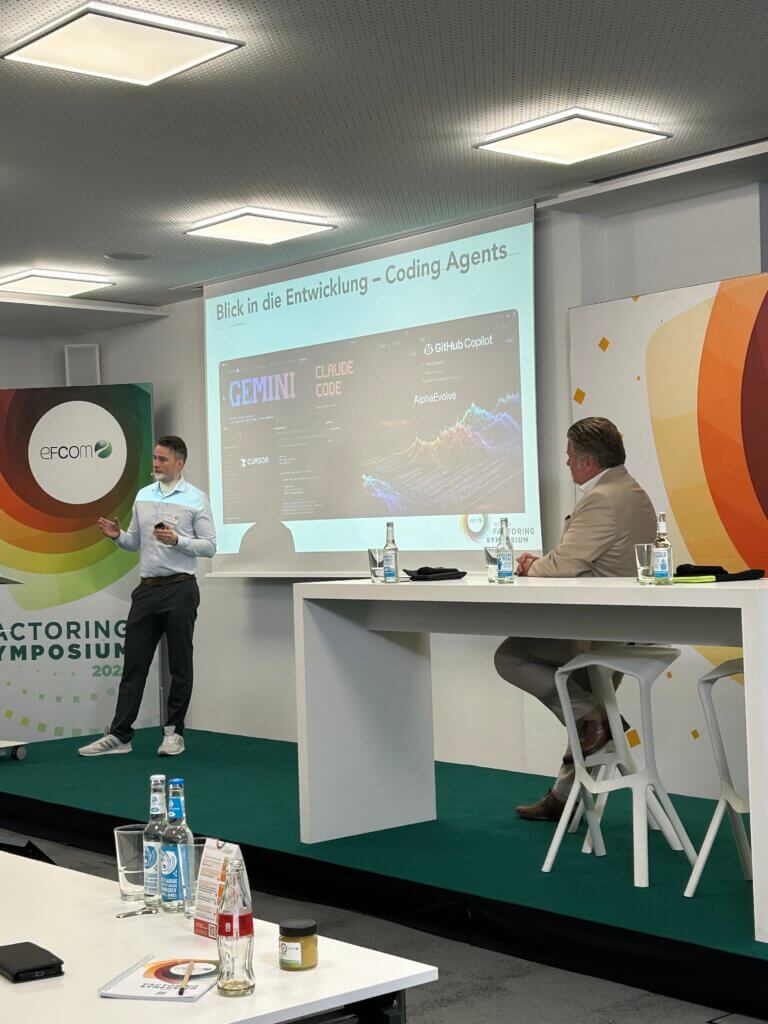
Left: Dr Björn Engelmann, right: Dinko Mehmedagic
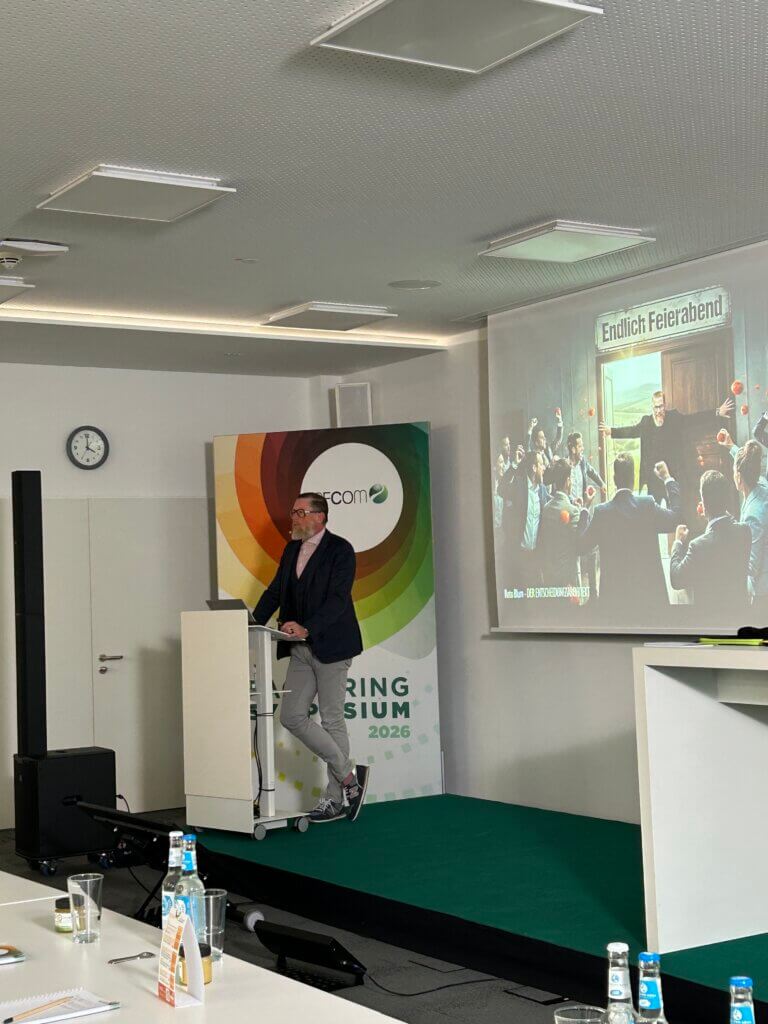
A knockout by AI? It might happen, but it might not.
To conclude, Reto Blum – also known as a ‘decision architect’ – explored the question of how our thinking and decision-making abilities are changing as a result of the increasing use of technology, and AI in particular. His central argument is that, whilst we now have more information and digital tools than ever before, this does not automatically mean that we make better decisions. Our brains are evolutionarily designed to conserve energy and react quickly to situations. That is why we often rely on intuition, habits and mental shortcuts.
Using various experiments – such as the Stroop test, the ‘Moses illusion’ example or the so-called confirmation bias – Blum demonstrated that we often overestimate our own decisions and favour information that fits with our existing beliefs. In fact, greater knowledge can even lead to poorer decisions if we do not critically examine how we arrive at a decision. Particularly in a complex and fast-paced world, experience and intuition are increasingly reaching their limits.
AI can exacerbate this trend if we use it merely as a substitute for thinking. It quickly provides plausible answers that we can easily accept without scrutinising them sufficiently. This carries the risk that we will analyse things less for ourselves, weaken our own judgement and become increasingly dependent on digital systems. Blum therefore argues that AI should be used not as a ‘crutch’ but as a ‘thinking enhancer’. We should question answers, seek counter-arguments, examine our own assumptions and consciously engage with challenging intellectual tasks. His central message is this: what matters is not knowing as much as possible, but the ability to think independently, to question and to make good decisions.